
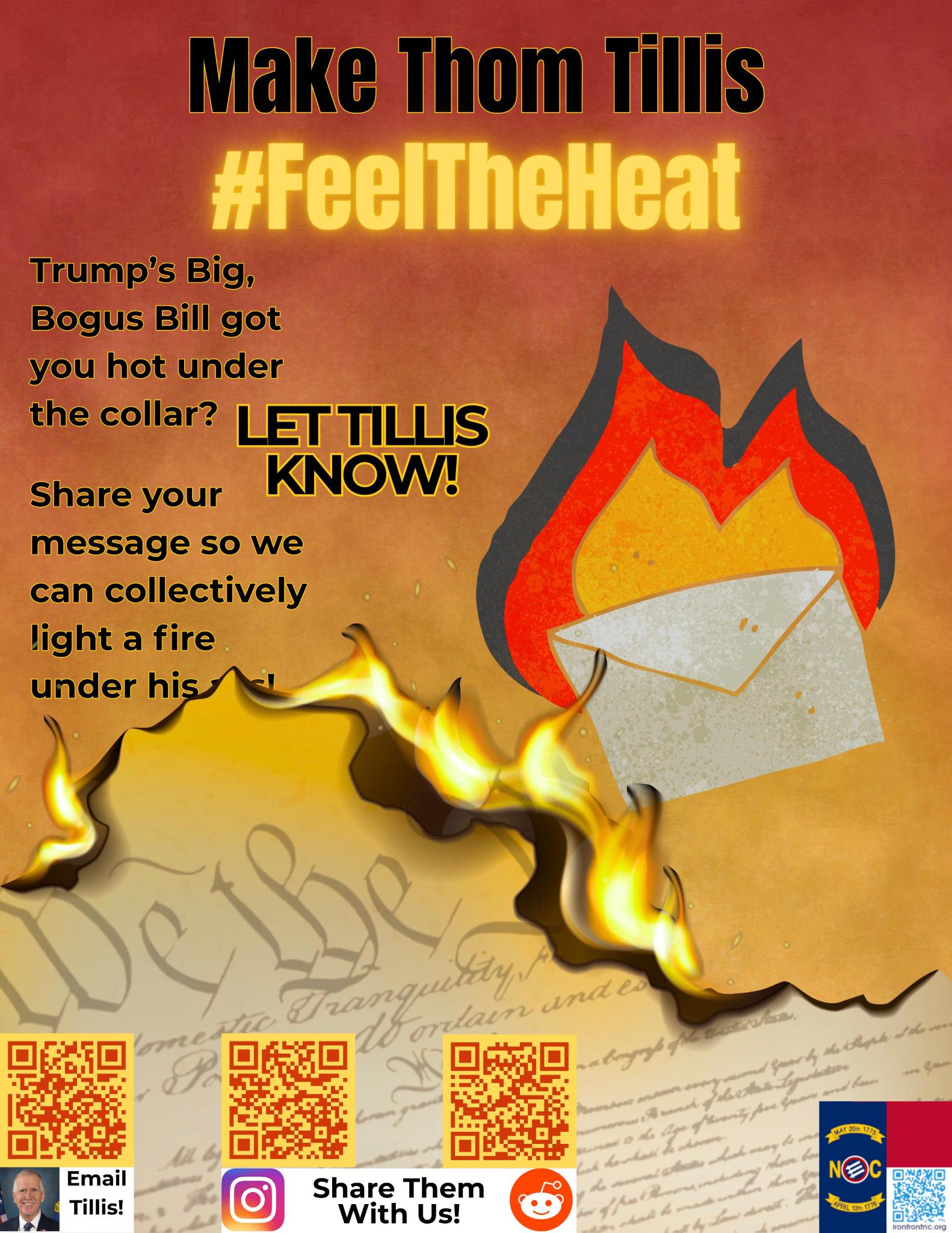
Hey there, Iron Front! I’m Skalding_Skald, and I’m hoping that I can make blowing up Thom Tillis’s inbox as easy as possible. One huge caveat before I begin: Everything I’ll be presenting was created with the help of AI. If you are uncomfortable utilizing AI, I completely understand your position and hope you’ll still join in making him Feel the Heat.
The first thing I’d like to present to you is a quick list of rhetorical tactics you can use in your letter. Basically, I had ChatGPT do its best to do its best to analyze Tillis’s stance on the Big, Beautiful Bill and come up with strategies more likely to sway him. There’s nothing special about them, so feel free to use as little or as much of it as you’d like, but I know that having a starting point is often all I need to get rolling.
✉️ Rhetorical Tactics for Convincing Tillis to Oppose the Bill
🎯 1. Praise then pivot
- Begin by thanking him for something specific he’s done—e.g., past support for clean energy, fiscal restraint, or defense readiness.
- Then pivot: “That’s why I’m urging you to oppose this bill—it runs counter to those very values.”
📉 2. Frame as fiscally reckless
- Use Tillis’s own principles: “This bill isn’t conservative—it explodes the deficit.”
- Emphasize real figures: “$3.8 trillion in new debt isn’t compromise—it’s surrender.”
🌪 3. Paint it as unfixable
- Don’t debate edits—declare the bill structurally broken: “This isn’t a bill to amend, it’s one to bury.”
- Use strong metaphor: “You don’t plug holes in a ship this compromised — you scuttle it before it takes the whole crew down with it.”
🛡 4. Appeal to NC’s specific interests
- Make it local: “North Carolina’s clean energy jobs and advanced manufacturing sector will be collateral damage.”
- Highlight constituency harm: “This bill gambles with the economic foundation of our state.”
🪖 5. Leverage his defense credentials
- Tap national security concerns: “This bill slashes across the board—including the DoD—and risks undermining readiness.”
- Tie military cuts to regional impact: “Cuts to the Military Personnel budget line might look abstract in D.C., but here in North Carolina, they hit real bases and real families.”
🧭 6. Frame a ‘No’ vote as leadership
- Reinforce courage: “Voting no takes more guts than going along with the party line.”
- Say it’s about legacy: “This is a moment to stand up, not fall in line.”
🔁 7. Echo respected voices
- Reference conservative critiques (e.g., Heritage’s misgivings): “Even those who once cheered the bill now warn it’s unsustainable.”
- Use Republican branding against it: “This isn’t Reagan-style reform—it’s Reaganomics without the brakes.”
📅 8. Add urgency without panic
- Make it timely: “The clock is ticking, and your voice could be the one that prevents a long-term mistake.”
- Keep the tone firm, not frantic: “This bill doesn’t meet the standard. It moves too fast, costs too much, and leaves too much unclear.”
Hopefully this can help you start conceptualizing what you might want to say in your letter. I’d probably pick 3 or so points and then pull examples from the media to support it (for example, I’d bring up Ed Martin’s blocked nomination if I were going to use bullet 6). The more you can personalize the letter, the better. If you will be personally impacted by the passing of this bill, please share that!
Now, I know many of us simply do not have time to put the level of effort we might like into all of the different tasks being asked of us right now. To that end, I also came up with a prompt that you can use with ChatGPT to generate a letter. Any time you use AI, check the work. The moment you forget to is the moment it will slip in nonsense. That said, this prompt should make creating a letter as easy as inputting the prompt, adding a few personal touches, and sending it on its way!
✉️Letter Prompt
Hi ChatGPT. I’m writing a letter to Senator Thom Tillis to ask him to vote against the “Big, Beautiful Bill.” I want this letter to sound like something I wrote — serious, focused, and grounded. No filler. No robotic phrasing.
I’m a constituent in [your town]. Please write a letter that does the following:
– Choose three of the following concerns to focus on and develop them clearly:
• It adds $3.8 trillion to the national debt — that’s reckless
• It cuts energy and manufacturing tax credits that NC jobs rely on
• It includes vague, sweeping cuts that could hurt military readiness
• Even conservative groups are backing away from it
• It looks like a rushed, election-year stunt, not serious policy
• Senator Tillis has taken principled stands before (like opposing Ed Martin’s nomination) — this calls for that same courage
– Use these rhetorical tactics:
• Start with shared values or past actions to build common ground
• Frame opposition as consistent with his principles, not partisan
• Argue the bill is structurally broken, not fixable
• Tie national problems to real risks in North Carolina
• Portray voting “no” as leadership under pressure
Please make the letter a little longer than average — around 250–300 words — to allow fuller development of the argument.
The tone should be clear, urgent, and composed. Avoid platitudes or inspirational fluff. End with a firm, direct ask: vote no — not to amend or negotiate — just reject the bill outright.
Feel free to change any part of the prompt you like (the tone, for example), and you can also further refine the draft that ChatGPT gives you – either yourself or with its help. Thanks, y’all!
No responses yet